
Orgone Motor Review: What is Orgone Energy?
Every month, the same quiet ritual repeats itself.
You open your electricity bill.
The number is higher again.
No explanation. No real choice.
You’re told demand has increased. Or fuel costs changed. Or the market adjusted. The language is always vague, always distant, always final.
Most people accept this as the cost of modern life.
But a small number of people ask a question that almost feels dangerous to say out loud:
What if energy was never meant to be scarce—or controlled—in the first place?
That question sits at the heart of the Orgone Motor story. It’s the same question that destroyed the career of a respected scientist, led to one of the most extreme acts of censorship in U.S. history, and continues to pull curious minds toward a topic many would prefer stayed buried.
This article is not written to convince you to believe anything.
It’s written to explain — fully, calmly, and honestly — what orgone energy is, what the Orgone Motor claims to do, and whether it’s worth your attention as a modern alternative-energy experiment.
The Day America Quietly Burned a Scientist’s Work
On August 3rd, 1956, federal officials stood at the Gansevoort Incinerator in New York City and supervised the destruction of more than six tons of books, research papers, journals, blueprints, and experimental devices.
This wasn’t wartime propaganda.
This wasn’t extremist literature.
It was the life’s work of Dr. Wilhelm Reich.
What makes this event so unsettling isn’t just that it happened — it’s how little noise it made. There were no national headlines. No public debate. No televised outrage. The destruction of scientific material was treated as administrative cleanup.
To this day, historians acknowledge this as the only known instance where the U.S. government ordered the mass destruction of a scientist’s published research.
That alone raises a question worth asking:
Why wasn’t Reich debated, disproven, or ignored like countless other controversial thinkers?
Why was he erased?
Who Wilhelm Reich Really Was (Not the Caricature)

Wilhelm Reich is often portrayed today as a fringe eccentric. That image is a modern rewrite.
In reality, Reich was deeply embedded in mainstream science for most of his career. He trained as a physician and psychoanalyst in Europe and worked directly under Sigmund Freud, treating patients rather than merely studying theory.
By his mid-20s, Reich was running one of the most respected medical clinics in Europe. His work was published, cited, and taken seriously. He was not operating outside the system — he was part of it.
Context matters here.
Reich lived during a period when scientific “laws” were being rewritten every decade. Human flight, atomic energy, superconductivity, and relativity all went from speculation to reality in a single lifetime. Ideas that once sounded absurd became foundational truths.
It was in this environment that Reich began asking whether life itself interacted with energy in ways science hadn’t yet explained.
What Is Orgone Energy, Really?

Orgone energy was Reich’s attempt to name something he believed he was observing repeatedly in experiments involving living organisms, atmospheric conditions, and electromagnetic behavior.
He described orgone energy as:
Naturally occurring and omnipresent
Not created by machines, but already present in the environment
More concentrated in living systems than in dead matter
Capable of movement, accumulation, and interaction
Modern science does not recognize orgone energy as a distinct, measurable force — and that must be stated clearly. But it’s equally true that modern science now studies phenomena Reich was touching decades early: bioelectric fields, atmospheric electricity, and energy gradients within biological systems.
Reich wasn’t claiming magic.
He was claiming there was more going on than existing models could explain.
The Orgone Energy Accumulator Explained Simply
To test his ideas, Reich built what he called orgone energy accumulators.
These were simple structures made from alternating layers of organic materials (such as wood or cotton) and inorganic materials (such as metal). The arrangement mattered more than the materials themselves.
Reich believed this configuration could concentrate ambient energy, much like a capacitor stores electrical charge without generating electricity.
Importantly, these devices did not produce power. They did not plug into anything. They were experimental tools designed to observe changes — temperature differentials, electrical behavior, biological responses.
This is often misunderstood. Critics frequently argue against claims Reich never made.
From Accumulation to Motion: The Birth of the Orgone Motor
The turning point came when Reich began asking a second question:
If energy can be accumulated, can it be directed into motion?
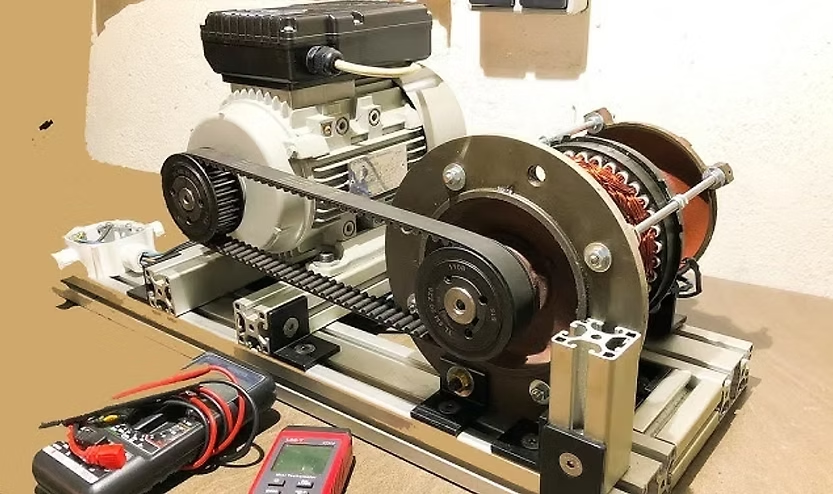
This led to what later became known as the Orgone Energy Motor.
According to Reich’s notes and reconstructions by later researchers, the device was designed to exploit magnetic and electromagnetic imbalance — creating a directional flow that resulted in sustained rotational movement.
This was not perpetual motion in the fantasy sense. Reich acknowledged thermodynamic limits. But physics allows systems that maintain motion for extremely long durations without continuous fuel input — planetary orbits being the clearest example.
The idea wasn’t “energy from nothing.”
It was energy from the environment, guided rather than consumed.
Why Reich Was Silenced Instead of Debated
Here’s where the story stops being theoretical and starts being uncomfortable.
Unorthodox ideas are common in science. Most fail quietly.
Reich’s didn’t.
Instead, the FDA issued injunctions. His devices were seized. His books were banned. All references to “orgone” were ordered destroyed. He was imprisoned for contempt of court after continuing his work.
In 1957, just days before a parole hearing, Wilhelm Reich was found dead in his prison cell. No autopsy was performed.
Regardless of whether Reich was right or wrong, the scale of suppression was extreme — and that fact alone keeps people asking questions decades later.
Today, when people talk about buying the Orgone Motor, they are not purchasing a finished generator.
They are purchasing:
Digital blueprints
Step-by-step construction instructions
Material and tool lists
Explanations of the underlying theory
It’s an instructional DIY product, not a utility replacement. That distinction matters.
The goal is not instant free electricity — it’s learning, experimenting, and building.
How Normal People Are Using It Today
Most people exploring the Orgone Motor fall into familiar categories.
Some are DIY builders who enjoy hands-on projects and experimentation. Others are off-grid thinkers interested in reducing reliance on centralized systems. Many are simply curious skeptics who want to understand the concept for themselves rather than dismiss it outright.
For most users, the value lies in:
Understanding how energy systems work
Exploring magnetic and mechanical principles
Building practical skills
Gaining a sense of independence
It’s less about replacing the grid and more about changing the relationship you have with energy.
Does the Orgone Motor “Work”?

This depends entirely on expectations.
If “work” means effortless, utility-grade power for a modern home, then no — that’s unrealistic.
If “work” means producing observable mechanical motion, demonstrating energy imbalance concepts, and functioning as a legitimate DIY experiment, then many users report meaningful results.
This is not belief-based.
It’s experimental.
Frequently Asked Questions
Is orgone energy scientifically proven?
No. It is not accepted by mainstream science.
Is the Orgone Motor dangerous to build?
No. It uses common materials and involves no combustion, radiation, or chemicals.
Is this perpetual motion?
No. Even proponents acknowledge thermodynamic limits.
Can it replace solar or grid electricity?
Not realistically for most households.
Why hasn’t it gone mainstream?
It lacks institutional backing, challenges centralized systems, and remains controversial.
Is this a scam?
It’s an instructional product. Its value depends on expectations, not promises.
Why Interest Is Growing Again

Energy prices are rising.
Trust in centralized systems is declining.
DIY culture is stronger than ever.
People aren’t necessarily looking for miracles.
They’re looking for options.
And when traditional options feel fragile, suppressed or forgotten ideas resurface.
Who the Orgone Motor Is—and Isn’t—For
This is not for people who want instant certainty.
It is for people who:
Question monopolies
Enjoy building and learning
Value independence over convenience
Are comfortable exploring ideas outside the mainstream
So… Is the Orgone Motor Worth Trying?
At this point, you’ve probably noticed something important.
This story never asks you to believe.
It asks you to look, learn, and decide for yourself.
That’s exactly why some people choose to explore the Orgone Motor — not because they expect miracles, but because they’re tired of being told that every meaningful energy solution has already been discovered, patented, and monetized by someone else.
The modern Orgone Motor isn’t sold as a finished machine or a magic box. What you’re actually getting are blueprints and instructions — a way to build, experiment, and understand an alternative energy concept hands-on, using simple materials you can source locally.
For some people, the value is practical.
For others, it’s educational.
And for a few, it’s philosophical — a way to step outside the usual “pay, consume, repeat” cycle and reconnect with how energy systems really work.
There’s also something else worth acknowledging.
If this idea truly has no merit at all — if it’s nothing more than harmless nonsense — then there’s no real risk in letting people examine it openly. The fact that Reich’s work was suppressed instead of debated is precisely why so many people feel compelled to see it for themselves.
That doesn’t mean you should suspend skepticism.
It means you shouldn’t outsource your curiosity either.
If you’re the kind of person who enjoys building things, questioning assumptions, and learning through direct experience, the Orgone Motor blueprints give you a structured way to explore an idea that history never allowed to play out naturally.
And if, after trying it, you decide it’s not for you, most people move on having at least gained a deeper understanding of energy, mechanics, and independence — which is more than most digital products offer.
In the end, this isn’t really about free energy.
It’s about whether you’re comfortable letting certain ideas remain permanently off-limits… or whether you’d rather take a small step, look behind the curtain yourself, and decide based on experience instead of permission.
That choice, at least, is still yours.
— Reviewed by Amey 🙂
Affiliate Disclosure –This article contains affiliate links. I may earn a commission at no additional cost to you.
Disclaimer – This content is for educational purposes only and does not guarantee financial results.